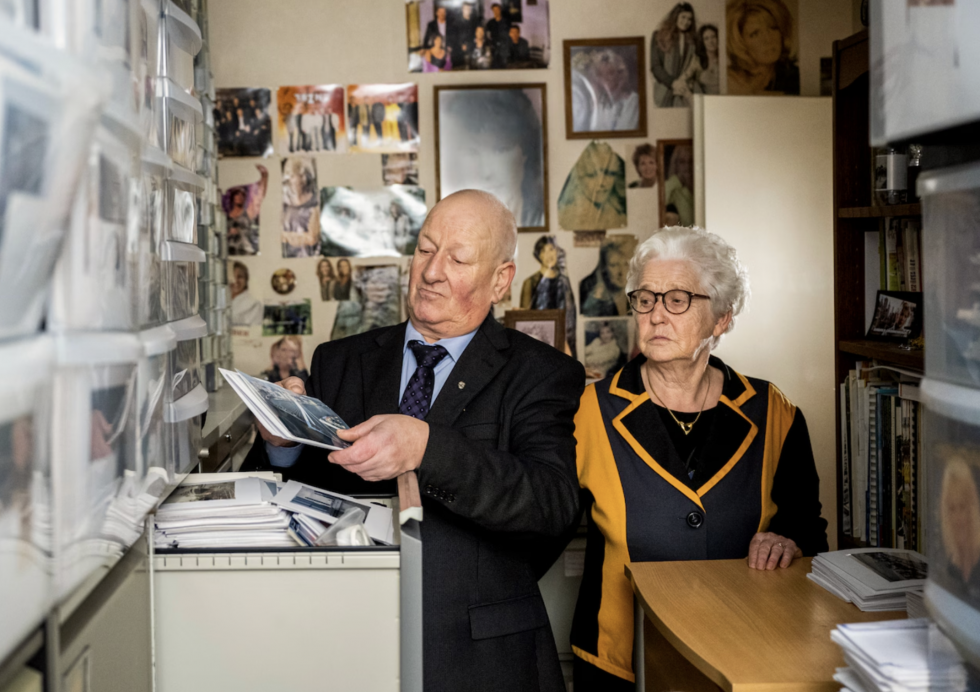
Photo: Tinus and Bep de Does in their home archive. Photo by Frank de Roo.
Spangen in Earlier Times
TINUS and BEP DE DOES
September 12 – October 25, 2026
Guest writer: Yazan Khalili
To celebrate Open Monument Day 2026 we are very excited to announce Spangen in Earlier Times, an exhibition by Tinus and Bep de Does. A pair of photographers and a pair in life, their work could be thought of in the important tradition of amateurism or as a hobbyist pursuit, dedicated to a chosen topic or activity not in search of professional prowess but instead driven by a self-directed care and curiosity. When Tinus first started photographing in 1964, it was to document his neighbourhood and the destruction of his childhood home, a process of transferring sentiment to print and an attempt to hold onto personal histories in the face of commercial redevelopment projects. Nearly twenty years later in 1983, Bep met Tinus, ‘the guy with the camera’, on the street as he was taking photos, striking up a conversation that eventually led to their romance. Once together and after Tinus gifted her a camera, Bep joined him on his photographic journeys, inheriting the passion herself as the two traversed the city in search of a scene.
Their sixty years of documenting Rotterdam on a daily basis—from major redevelopments like the one the Justus van Effencomplex went through, to countless demolitions and shots of neglected streets—has produced an incredibly extensive and forensic archive of an ever-changing city, one forever at the mercy of gentrification and big capital. Totalling over 700,000 images, their physical archive is stored in bulging filing cabinets in their home office, with no digital counterpart in sight. Over the years, they have drawn on their collection to publish now sold-out and sought-after books on each suburb of Rotterdam and produced many exhibitions of their work. Shot on simple digital point-and-shoot cameras and reproduced with meagre means—endless trips to local drug stores to print out copies for filing and handwritten captions pinned to noticeboards for carrying context—their exhibitions become an illustration of community spirit and a commitment to that which has not always been noticed, primarily recording what might no longer be there the next day alongside creating a kind of family album of a whole city, fingerprints on the lens and all. This is further accentuated by the fact that their archive is supplemented by the donations of others, as Tinus and Bep often ask people to share their personal photos, always travelling together to pick them up in person. For this occasion, they will present their materials on our neighbourhood of Spangen, an area they have frequented many times over, eager to celebrate it in the face of a reputation and history that has left the neighbourhood stigmatised and chronically overlooked by social policy.
This exhibition is also a first step towards thinking about the formation of a functioning archive for A Tale of A Tub, one which embraces the informal and interpersonal ethos that underpins Tinus and Bep’s collection. Throughout the exhibition, members of the public can bring images of the Justus van Effencomplex from their personal collections to duplicate on a photocopier, materials that will eventually comprise part of the archive—one which will be as much a record of the institution as it is of the building that started it all. This is also in the spirit of a number of recent projects that have themselves archived the complex through art-making, such as Brianna Leatherbury’s engagement with the contested history of heating through the 104 years of the building’s life; or Katrina Palmer’s fictional interrogation of its heritage, her literary approach, oftentimes born from anecdote, paving the way for alternative ways of doing historical work. Accompanying the exhibition is a bulletin text by Yazan Khalili, which centres the photocopier as an institutional tool to explore the possibilities of inverted resources and communal infrastructures. Spangen in Earlier Times is curated by Lisanne Janssen and Isabelle Sully.
Biographies
TINUS en BEP DE DOES have been documenting the history and transformation of Rotterdam on a daily basis for more than sixty years, with a particular focus on the south of the city where they also reside. Since meeting in 1983, they have held many exhibitions and published countless books on the suburbs of Rotterdam, including Rotterdam Bloemhof in vroeger tijden (1999), Spangen in vroeger tijden (2008), and Rotterdam Beijerlandselaan – Groene Hilledijk (1997). In 2024 they presented 60 Years of Rotterdam Through the Eyes of Tinus and Bep de Does, a self-initiated exhibition that contained an extensive selection of photographs taken between 1964 and 2024. Later that same year, they starred in the documentary De toekomst is failliet [The Future is Bankrupt], which chronicles the demolition of all of Tinus’s childhood homes as means to critique the agenda of the city as it relentlessly sells itself to big capital.
YAZAN KHALILI is an architect, visual artist and researcher who lives and works out of Palestine and Amsterdam. Currently, he is a PhD candidate in the Amsterdam School for Cultural Analysis and recently finished his guest artist in residence at the Rijksakademie, Amsterdam (2020–2022). In 2020, he co-founded Radio Alhara, and in 2019 he co-founded The Question of Funding collective.